
The Bitcoin Exit
Conviction is common. Walking through the door is rare.

For most of financial history, there was no exit.
If the money of your country was being quietly debased - and it almost always was - your choices were to hold it anyway, chase risk you didn’t want, or buy things that were hard to move, hard to divide, and easy to tax. You could complain about the system, but it was a closed system; all economic participation was within it, and you could not leave it. Financial repression has two ingredients - inflation running above the risk-free rate, and rates held down so you can’t escape it by simply saving - so you are forced to either invest (take on risk) or spend and consume (often thereby driving mal-investment or mal-consumption). That’s not a conspiracy theory; it’s the design of every fiat system: an imposed credit-based system requires your money to keep moving.
Bitcoin is the first genuine exit. Not a protest vote, not a trade - a door into a completely parallel system. A neutral, borderless, confiscation-resistant place to stand that no committee controls and no state can quietly dilute. Failing states have always tried to bar the exits; this is the first one that can’t be barred.
This essay is about actually walking through it - because I’ve taken the steps myself, and I notice that few others have done so.
Conviction is not the bottleneck
Here’s the strange thing about Bitcoin in 2026: the arguments are widely available. The fixed supply, the fiat debasement math, the seventeen-year track record - anyone can find them in an afternoon. And yet.
Peter Thiel said courage is in far shorter supply than genius, and Michael Saylor sharpened it for this exact subject: Bitcoin is not an IQ test, it’s a courage test. I’d put my own version this way: my conviction doesn’t come only from having carefully evaluated the alternatives and arrived at a conclusion - though I have - it comes from noticing that 99% of people aren’t yet even asking the questions.
In some ways, that’s understandable. Most people do what they’ve always done, or what everyone around them is doing - and bitcoin is not yet either. And in a relatively functional economy the problem never feels acute: the debasement is real, and may even be recognized, but nothing forces the question. The exit isn’t crowded. The door is standing open in a room where almost nobody has turned around.
So the bottleneck isn’t understanding. It’s the gap between recognizing something and doing something about it. Most people who “have a bitcoin position” own an amount that would make no difference to their lives in any future where they turn out to be right. That’s not conviction; that’s a souvenir.
Why your brain fights the exit
Part of the gap is temperament. But a bigger part, I think, is human wiring: bitcoin’s movement along the power law can seem exponential, and most of us can only think linearly. Our intuitions were built for arithmetic - save a little, get a little. Really understanding bitcoin means holding an expectation of orders-of-magnitude increases in value over a long enough timeframe - and that is exactly the kind of expectation the linear brain refuses to believe.
Here’s what that looks like in practice. There’s an investor who bought $30 of bitcoin every single day - coffee money. On November 19, 2024 - 2,880 days and $86,400 in - the stack crossed one million dollars. The story was widely reported when it happened; I recomputed it from bitcoin’s actual price history - the same data behind the Power Law exploration - and the arithmetic checks almost to the dollar. And an honest coda the chart below doesn’t hide: in the drawdown since, that same stack is worth about $715,000. The ride down is part of the ride - and $30 a day keeps buying.
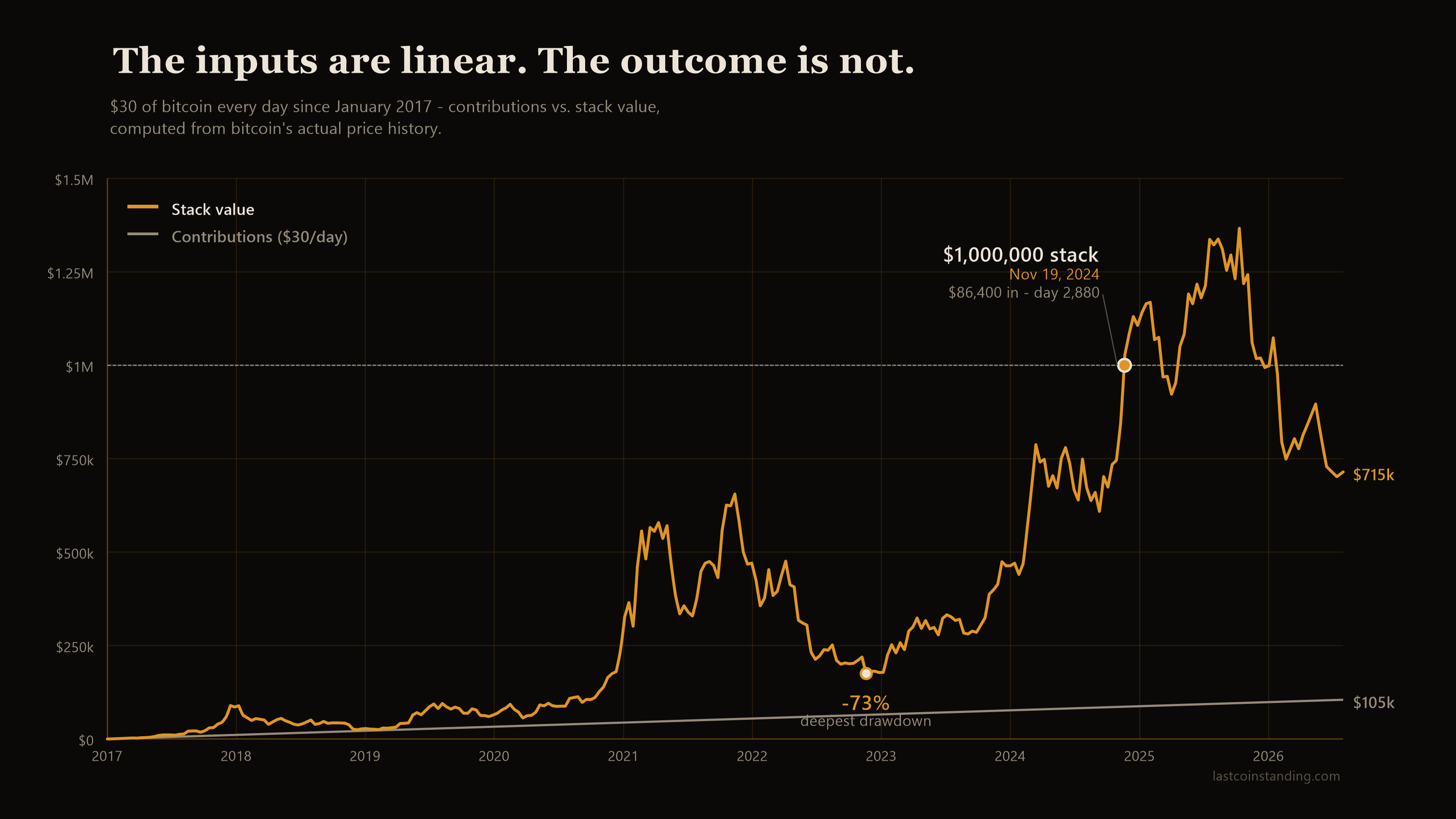
Anyone can imagine allocating $30 a day. Almost no one can believe it becomes a million dollars in under eight years. That’s the trap - the cost is easy to picture, easy even to dismiss as insignificant, yet the benefit sounds like a lie, so the two never connect.
Read that again slowly, because your brain will try to file it as a lottery story. It isn’t. There was no timing, no genius, no leverage, no luck - just a small fixed act, repeated through two bull cycles and two 70%+ price drawdowns; the only ingredient was discipline. The inputs are linear - defined and manageable. The outcome was not (and still is not). The story feels impossible precisely because the brain that’s reading it prices in straight lines.
Daily buying, or dollar cost averaging (DCA), is not so much a return-optimization strategy. It’s something better and easier: conviction made mechanical. It takes the decision you’re worst at (when, how much, is now a top, is now a bottom) and replaces it with the decision you’re best at: a standing order. It converts courage from a heroic one-time act into a boring habit. And boring habits are the only vehicle most of us can actually ride through a 70% drawdown without jumping off.
There’s an irony in the psychology here. Most of life’s big inflection points reward the instinct “don’t just stand there - do something.” Once you take the bitcoin path, the ideal becomes the reverse: “don’t just do something - stand there.” That is how an investor drip-feeding $30 a day crossed a million dollars - by standing there, daily, for the better part of a decade.
The bigger step: the retirement stack
For a lot of people - me included - taking an inventory of the opportunities available reveals something significant: the largest pool of capital I had was in my retirement account. I’m not about to give financial advice here - retirement money is sensitive, especially as retirement gets close - but I’d be remiss not to share some of my own journey.
So I moved a portion of my retirement to bitcoin. Not all - a deliberate portion, sized so that I’d be genuinely exposed to the future I consider likely while still left standing if I’m wrong.
Every country is different; my experience is a U.S. one. The path I used was a self-directed IRA. What I had absorbed without ever checking was the common assumption that retirement funds are locked inside the employer plan’s menu - and it turned out not to be true. Funds sourced from previous employers, my own contributions among them, and all their growth over the years, were fully mine to redirect; the big plan administrators handle that extraction routinely. Once the self-directed IRA existed, buying bitcoin inside it - even in self-custody, through providers built for exactly this - was the easy part. (There is often also an additional brokerage window available inside employer plans - in the best cases it opens up bitcoin ETFs or bitcoin-related equities, though not self-custody. I didn’t use it.)
The mechanics vary by country, account type, and year, so the right version of this for you is a conversation with your own accountant and plan administrator, entered with your own conviction - which may differ significantly from mine - and your own situation, including your age and distance from retirement. My main point is simpler: the bitcoin-for-retirement paths exist, and have existed for years - but most people never even consider them.
What I’ll say is the part that generalizes: the move was practically easier than I expected. The system’s inertia is mostly friction, not walls. The door opens if you push. And moving that portion gave me a peace of mind and a sense of personal agency I would never have gotten any other way.
One honest caveat: a bitcoin position in a retirement account should give you a sense of relief and security. If what it gives you instead is risk and anxiety, it’s not for you - and no one should talk you into it.
What the exit actually is
Here’s the reframe that took me the longest: taking the exit doesn’t mean leaving.
You may hope never to need it - that’s fine; that’s what exits are for. Owning bitcoin is holding the latent power to operate outside the conventional fiat system, and like any option, it has value even if never exercised. It changes your posture. It is, quietly, a constraint on the system itself: every person holding an exit is a small check on how badly the money can be abused before people start walking. Lawrence Lepard’s image is the one I can’t shake - the dollar is the Titanic, and bitcoin is the lifeboat: when you’re on the Titanic, what is a seat on the lifeboat worth - and there are not enough seats.
That’s why I think of what’s coming not as a run for the exits but as an exodus - and the difference matters. A run is panic, late, all at once, at whatever price the door charges in the moment. An exodus is early, deliberate, and walked at your own pace: thirty dollars a day, a rebalanced retirement account, a stack that grows on a standing order while 99% of people haven’t yet asked the first question. The exit is open now, at today’s price, in today’s calm. The whole art is to walk through it before you need to run.
Conviction is common. Souvenirs are common. The exit is taken one deliberate, boring, repeated step at a time.
Start stepping.
Disclosure: I hold bitcoin, including in a retirement account. Nothing here is financial, tax, or retirement advice - it’s what I did and why.