
How Legitimate is STRC?
Strategy's "Stretch" stock, or STRC, has had a tumultuous initiation to the financial markets, enduring significant skepticism and disdain, but how much of that is warranted? Let's explore.

I made an infographic a few months ago to explain a thesis I’d been carrying around: that STRC — Strategy’s bitcoin-backed variable-rate perpetual preferred — is a glitch being arbitraged. On one side of the financial universe sits bitcoin, compounding at a historically enormous but wildly variable rate. On the other side sits the fiat fixed-income world, paying ~4.3% nominal on a ten-year Treasury — a yield that, measured against real-world inflation rather than the official CPI, is somewhere between an underwhelming and negative real yield. Between those two shores there was, for most of financial history, nothing. No seat. You picked a shore.
STRC is an attempt to build that middle seat: a preferred stock backed by a senior claim on the largest bitcoin treasury on earth, paying a double-digit cash yield, with a dividend rate the board adjusts monthly for the stated purpose of keeping the price pinned at $100. Take bitcoin’s growth engine, strip out its volatility, hand the smoothed yield to people who want income. The middle of the bridge. (The cleanest articulation of this arbitrage framing belongs to Fred Krueger, who called the preferred stack a unique third position between bitcoin and bonds — my version is a synthesis of his argument, Jeff Walton’s work on the daily-accrual mechanics, and my own conviction about the glitch.)
So I made the infographic. Bitcoin on the left: ~80% historical CAGR, very high volatility. Treasuries on the right: ~4.3%, capital preservation. STRC in the middle: 11.5–12.5% yield paid monthly, $100 par value anchor, low targeted volatility, 4.6x–5x asset coverage.
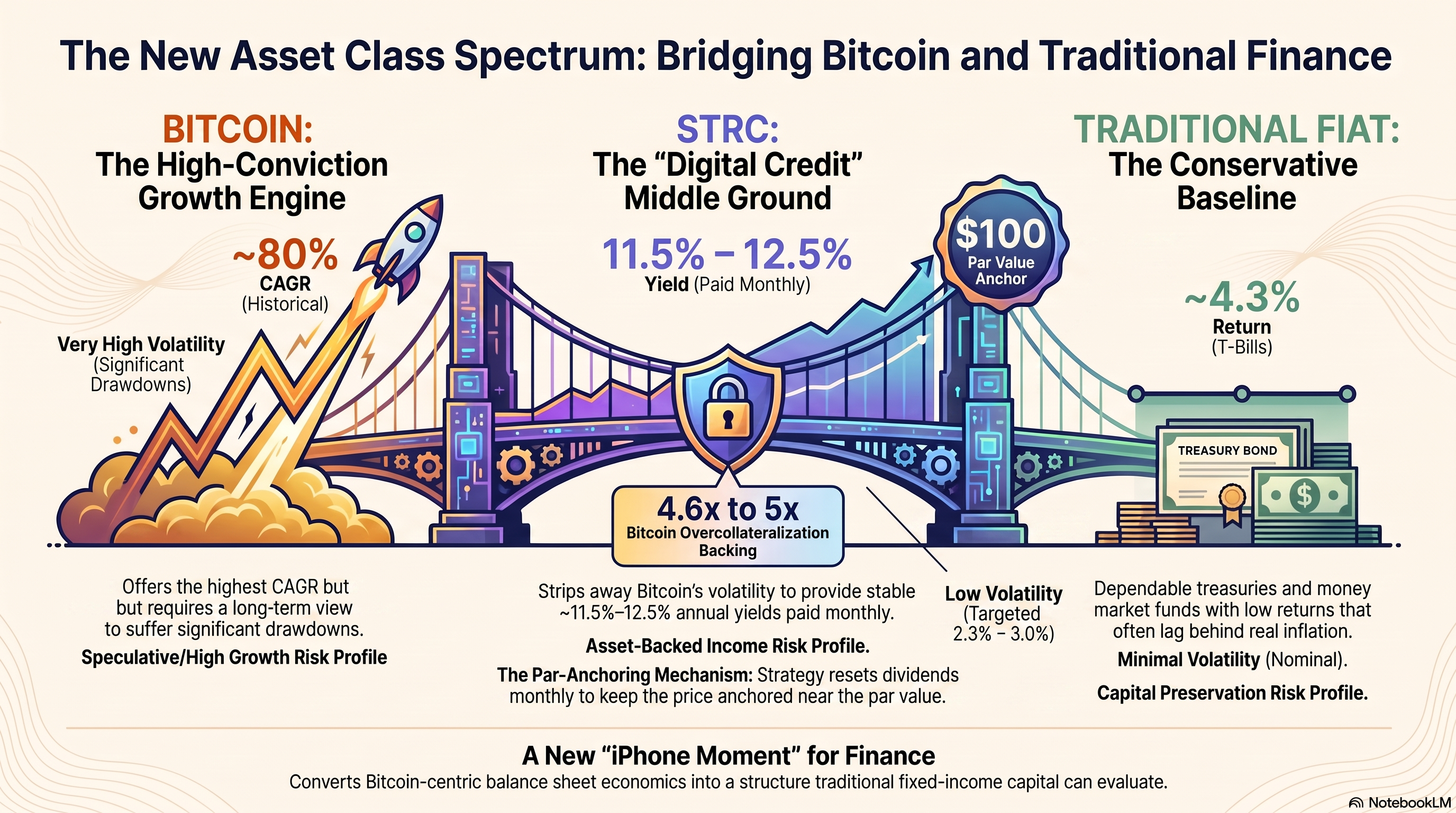
The $100 par anchor: written before June 2026. STRC spent May–June de-anchoring, touched $71.25 on June 26, and sits around $88 as I write (July 30, 2026). The peg mechanism existed the whole time. It did not hold.
4.6x–5x asset coverage: true on a gross basis — bitcoin treasury divided by STRC’s notional alone. Count everything senior to STRC (the $6.7B of senior converts and the $1.28B of senior STRF) and coverage is ~3.1–3.2× at current prices. Still substantial, but not the number implied by the infographic.
I’m publishing a new infographic, below, with those corrections instead of quietly fixing it, because the episode between then and now is the most instructive thing that has happened to this instrument class, and worth scrutinizing and learning from it.
What the market taught me
The de-anchoring forced the question every STRC holder and skeptic is really arguing about, and I want to state it plainly rather than argue around it: is a persistent 12% discount to par value the arbitrage widening — the middle seat going on sale — or the thesis leaking — the market concluding the seat doesn’t really exist?
We will have to see how it plays out, though I have an opinion. The same $12 coupon on an $88 price is a 13.6% effective yield; quite a yield in any fixed income conversation. And an instrument whose entire design goal is trading at $100, trading persistently below it despite monthly rate hikes, is the market saying it demands more than the mechanism delivers; a seat with doubts about its structural integrity. I built an interactive page that computes both readings live but doesn’t pick sides - the numbers there update with every bitcoin tick, and every claim I make below can be stress-tested against it: https://lastcoinstanding.com/strc-below-par
Here, though, is my newsletter, not my tool — so I get to voice my opinion.
Where I land: the seat got cheaper, and the builder showed up with tools
Three things moved me from wrestling to leaning firmly toward the widening-arb reading, and none of them is vibes.
First, the issuer’s response was structural, not cosmetic. On June 29 Strategy formalized what it calls the Digital Credit Capital Framework: rate raised to 12%, payouts moved semi-monthly, a $3.75B USD reserve (about 25 months of preferred dividends), a policy of issuing no new STRC below par, a $1.25B bitcoin monetization authorization — and a $1B buyback program that made its first purchases in late July: $25M of STRC retired at an average of $86.52. Sit with that arithmetic: retiring a $100-par share at $86.52 extinguishes a $12-per-year perpetual obligation — roughly a 14% return on every buyback dollar, funded from outside the preferred. When the seat trades at a discount, the seat’s builder is now a standing, disciplined buyer of it. That is what defending an arbitrage looks like when it’s done with a balance sheet instead of a press release.
Second, the suspension question — the bear case’s crown jewel — is weaker than it sounds, and I held this view even when suspending was openly debated in June coverage. Yes: the dividend is board discretion, suspension is contractually available at any time, and because STRC is preferred equity rather than debt, unpaid dividends simply accrue — no default, no bankruptcy trigger. But look at what pulling that lever actually costs. Arrears accrue as a growing cumulative claim. Rate cuts become legally barred while any arrears sit unpaid. Payments across the junior stack gum up. And - the part I find close to dispositive - the entire capital framework depends on preferred markets staying open to this issuer forever. Suspending the flagship preferred’s dividend to save a few hundred million, while sitting on 25 months of dedicated reserve, would torch the very market Strategy is trying to grow and occupy, with a sustainable competitive advantage if not near monopoly. There is no need and there is no upside.
Saylor has said they can fund these dividends for decades. Investor Khing Oei put the market-structure version of it best during the June debate: the question isn’t really will they suspend - it’s what discretionary capital costs when the issuer chooses not to defend par. The July buybacks are the issuer choosing to defend it.
Third - and this is the theme I keep coming back to - nobody has ever run this instrument before. A bitcoin-collateralized, variable-rate, perpetual, par-targeting preferred is a genuinely new species. Its entire trading record is one year long, and that year contained one full bitcoin drawdown and zero bull legs. Of course the first storm found the design’s soft spots. Of course there were mid-course corrections — the rate ratchet, the reserve policy, the buyback pivot are learnings, not confessions. I’d say the same about the criticism: the pile-on against Saylor and Strategy tracks the bitcoin drawdown almost perfectly, the way Normies’ criticism of bitcoin itself has tracked drawdowns. Bear markets manufacture skeptics; bull markets quietly retire them. My base case is that a bitcoin bull leg does to this discount what it has always done to bitcoin’s own obituaries. (And yes — the common stock is, in broad strokes, a levered play on bitcoin, which is a story for another day and another author; this piece is about the STRC instrument alone.)
The user base STRC is actually for
Here’s the part of my thesis the episode sharpened rather than dented. STRC was never really built for Bitcoiners. If you have the conviction and the time horizon to own the uncapped asset, own the uncapped asset — my own site’s STRC page asks, in its bluntest row, “if the case is ‘wait for bitcoin to recover,’ why not simply own bitcoin?” — and for most Bitcoiners that question answers itself.
The seat was built for the other shore: the income investor sitting in Treasuries and money-market funds at ~4.3% nominal — a return that many measures of real-world inflation quietly eat whole. That investor is not making a bitcoin bet when they buy STRC; they’re making a coverage bet: that a ~$58B pool of assets will keep servicing a ~$10.5B preferred claim with ~3× asset coverage coverage and a 25-month cash buffer, in exchange for roughly triple the yield. That trade at least beats the melting ice cube is, thought it isn’t ‘risk free’ - there are of course risks, but they should be recognized and understood (bitcoin-correlated mark-to-market, discretionary dividend, no maturity), not carelessly inflated.
Many critics of STRC are Bitcoiners, who make the mistake of comparing the instrument to bitcoin itself, and find it wanting, suggesting investors should just buy bitcoin itself (case in point is Parker Lewis in a recent What Bitcoin Did episode). Instead STRC should be compared to conventional fiat fixed income, especially US Treasuries. The potential users base for STRC never was and never will be Bitcoiners, but Normies holding fiat Treasuries. And those Normies who want (or need) reliable yield have zero interest in Bitcoin with it’s variable returns and high vol; they still want the reliable yield, but now they have the option of a much higher yield - one that is never possible in the conventional fiat world (not without undertaking risk), but is instead possible in the ‘glitch’ between the Bitcoin and fiat worlds - the portal intersection that makes STRC possible.
But is there ever an STRC case for Bitcoiners?
At the top of a bull market, a Bitcoiner could make the case to move from bitcoin to STRC tactically - as a yield-bearing waiting room while rebalancing out of the bitcoin spike (perhaps better than moving to non-yield-bearing cash): on the surface this can sound interesting, but keep in mind that based on the short record we have for historical performance, STRC fell 29% peak-to-trough while bitcoin drew down. In this regard there was a leak, a trade-off, that at least so far suggests it would have been a bad strategy. That said, it may leak less, as the instrument matures and the holder base deepens.
The mark-to-market on my own thesis
So: the original infographic was right about the shape and wrong about two labels. The middle seat exists; the glitch is real; the arbitrage between bitcoin’s engine and fiat’s melting ice cube is, if anything, now wider at $88 (the discount) than it was at $100. What the episode corrected was my precision - par is a target defended by levers, not a law - and what it revealed was better than what it corrected: an issuer willing to spend real balance sheet defending the seat, and an instrument that bent through its first storm without breaking.
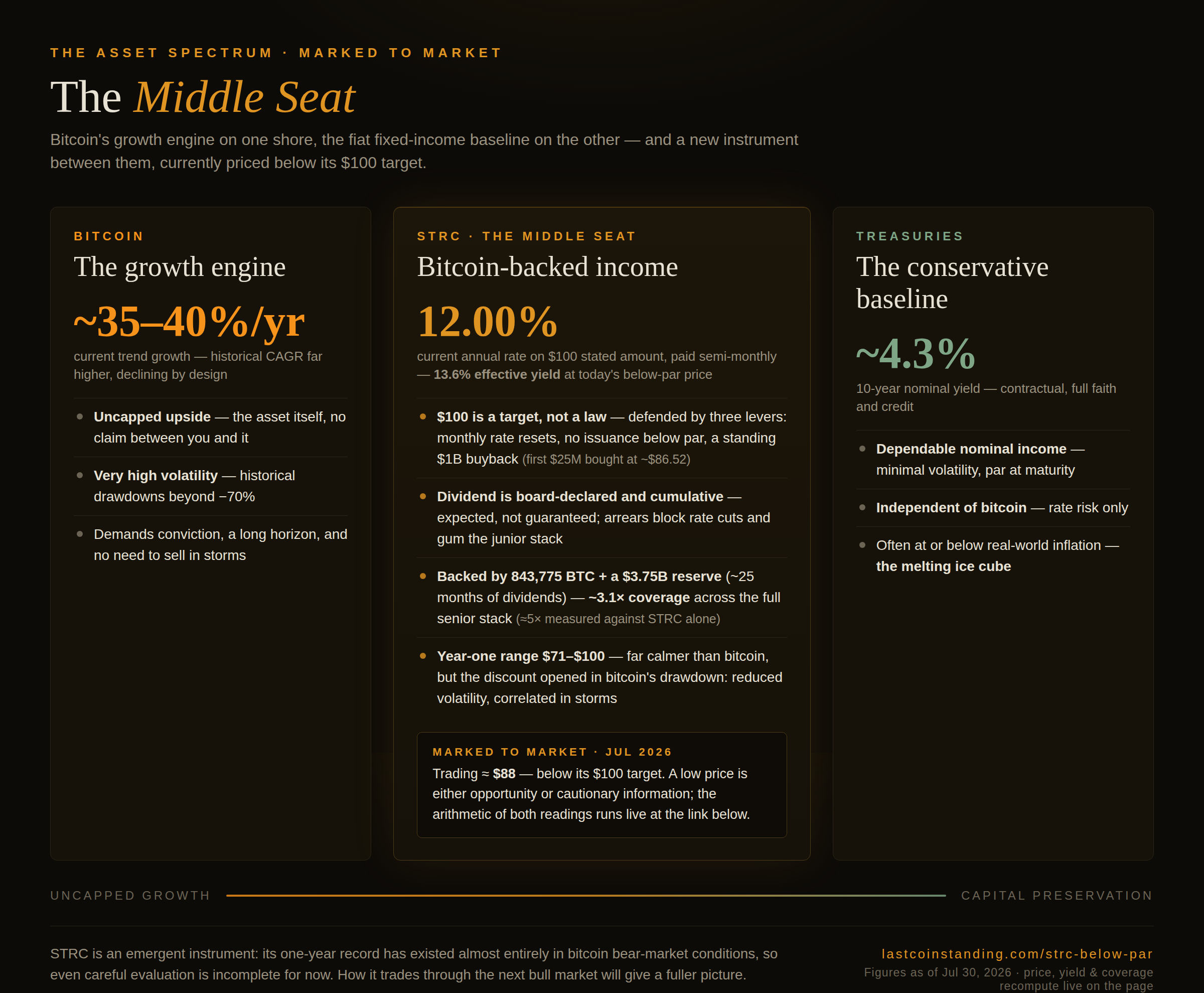
What would change my mind? Numbers, not narratives — the same ones on the live board: the reserve burning down without par recovering; all claims coverage impaired for quarters, not weeks, unexpected dividend suspensions. Until then, my read is the one I started with initially, albeit now with some scar tissue: the seat is real, the seat got cheaper, and the market is still learning what it’s sitting between.
Run the numbers yourself — every figure in this piece, live: lastcoinstanding.com/strc-below-par
Credits: Fred Krueger (middle-seat arbitrage articulation), Jeff Walton (accrual mechanics), Khing Oei (June analysis). Figures as of July 30, 2026 — STRC ~$88, BTC ~$64K; the page recomputes live.
Disclosure: I have never held any position in STRC or MSTR; I hold bitcoin.